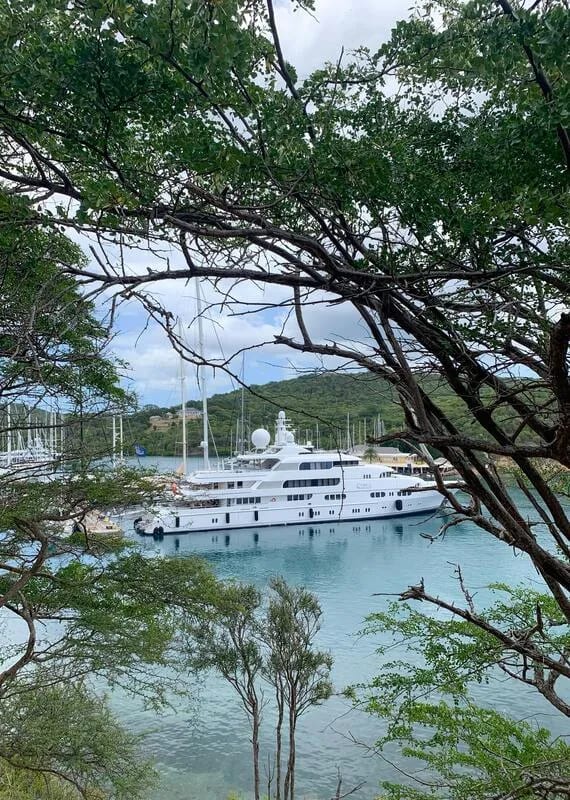
The Caribbean is a winter charter destination with a hard weather calendar. Get the timing right and it is the best sailing water in the Atlantic.
The Caribbean charter season exists because of two facts. The first is that from roughly December to April, the trade winds blow steadily from the east at a comfortable 15 to 20 knots, the sky is mostly clear, and the water sits around 27 degrees. The second is that from June to November it is hurricane season, and the serious charter fleet leaves. Everything about planning a Caribbean charter follows from those two facts.
The season, precisely
Mid-December to mid-April is prime. Christmas and New Year is the busiest and most expensive fortnight of the year anywhere in the charter world, and Caribbean berths and boats for that window are often reserved a year ahead. January to March is the quieter, better-value heart of the season with the most reliable weather.
May and late November are shoulder — cheaper, still generally fine, but you are closer to the edge of the weather window and should be comfortable with a flexible plan. June through November, most guests are chartering in the Mediterranean instead, and the yachts follow them across the Atlantic.
The three main cruising grounds
"The Caribbean" covers a lot of sea. For charter purposes it splits into a few distinct areas, and they are genuinely different trips.
The British Virgin Islands
The BVI is the beginners' Caribbean, and that is a compliment. The islands sit in a tight cluster around the Sir Francis Drake Channel, so you are rarely more than a couple of hours' sail apart, always in sight of land, and always in protected water. The anchorages — the Baths on Virgin Gorda, the Bight on Norman Island, Cane Garden Bay on Tortola, the sandbar at Anegada — are famous for good reason. This is the easiest place in the region to have a relaxed week, and where most catamaran charters go. The beach bars are an institution: the Soggy Dollar at White Bay, the Willy T floating bar, Foxy's on Jost Van Dyke.
St Barths and the northern islands
St Barths is the Caribbean's answer to Saint-Tropez: a small, chic French island with a harbour full of superyachts, particularly over New Year. Pair it with St Martin, Anguilla and its extraordinary beaches, and the quieter St Kitts and Nevis, and you have a week with more contrast — a night in Gustavia, a day anchored off a deserted cay. The distances are a little longer than the BVI and the sailing more open, which suits people who want the passages to feel like sailing.
The Grenadines
The southern Grenadines — Bequia, Mustique, the Tobago Cays — are the wildest and least developed of the three. More sailing, fewer marinas, the best snorkelling in the region by some distance, and a real sense of being somewhere remote. The Tobago Cays, a cluster of uninhabited islands protected by a horseshoe reef, with turtles in the shallows, is one of the great anchorages anywhere. This is the Caribbean for people who have done the BVI and want more.
Catamaran or monohull
The Caribbean is catamaran country. The steady beam-reaching trade winds suit them, the flat sailing is comfortable for guests who are not sailors, the shallow draft opens up anchorages a monohull cannot enter, and the deck space matters when you are living outside for a week. Monohull sailing yachts and motor yachts both charter here too — a large motor yacht makes sense for a group that wants range, air conditioning throughout and less dependence on wind — but if you have a choice and no strong preference, the cat is usually the right call. We touch on this trade-off in our buyer's guide too, since it applies to ownership as much as charter.
What a week actually looks like
Trade-wind sailing has a rhythm. You wake at anchor, swim before breakfast, sail two or three hours in the morning when the wind is steady, arrive somewhere new for lunch, spend the afternoon in the water or ashore, and settle for the night before the light goes. It is not a restful-in-a-spa-sense holiday — you are outside, salty and a little sun-tired every evening — but it is the good kind of tired, and the sailing itself is a large part of the point in a way it is not everywhere.
Getting there
Access is via Antigua, St Martin, or Tortola for the BVI, usually with a connection through a US or European hub. Build in a buffer day at each end — Caribbean connections are not always same-day, and you do not want to lose a charter day to a missed flight. A night in a hotel before boarding is a good idea regardless: you start the charter rested rather than jet-lagged.
If your yachting is normally a Mediterranean summer, a Caribbean week fills the other half of the year with the best trade-wind sailing in the Atlantic. Our Caribbean charter fleet covers all three cruising grounds — talk to an advisor about which one and which window fits.